
Key Highlights:
- EPA’s proposed revisions to the NOx rule could lower the cost of new heavy-duty trucks by thousands of dollars per vehicle while maintaining the vast majority of projected emissions reductions.
- The proposal incorporates key recommendations advanced by ATA, reflecting years of industry advocacy aimed at making emissions standards achievable and affordable.
- Six major changes would affect fleets and manufacturers, including rescinding expanded warranty requirements, delaying longer useful-life standards, increasing flexibility for specialized vehicles, creating nonconformance penalties, replacing speed and power derates with driver warnings, and updating technical certification requirements.
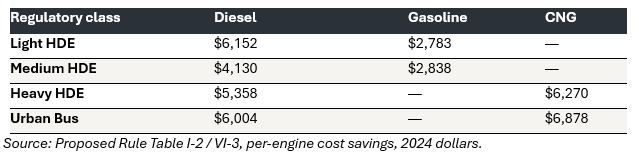
Last week, EPA proposed new NOx standards that could reduce the cost of new diesel trucks by as much as $6,000 and generate a $12 billion net saving to truck purchasers. To celebrate this rulemaking, ATA President & CEO Chris Spear joined EPA Administrator Lee Zeldin on the National Mall to discuss the forthcoming benefits to the supply chain.
EPA’s announcement represented the culmination of years of advocacy led by ATA. Significant changes are coming for MY 2027 trucks. Prior to these proposed changes, manufacturers would have been forced to pass on significantly higher costs, and truckers were staring down the barrel of being forced to adopt unproven and unreliable engine technologies.
Earlier this year, ATA submitted a letter to EPA with suggested modifications to the unworkable NOx requirements that were finalized in 2023. EPA’s proposed rule adheres to those recommendations.
Here's a breakdown of the six proposed changes that every fleet should know:
1. Extended Warranty Requirements Would Be Rescinded
The biggest cost driver in the 2023 rule was not the engine technology itself—it was the dramatically expanded emissions warranty.
Under the proposed revision, EPA would rescind the extended warranty provisions and retain the current warranty structure for model year 2027 and later engines. That means maintaining today's 5-year/100,000-mile emissions warranty rather than moving to the 10-year/450,000-mile warranty for heavy-duty trucks as prescribed in the 2023 rule.
As a result, EPA projects that manufacturers will pass these savings on to buyers:
2. Longer Useful-Life Requirements Would Be Delayed
The 2023 rule significantly extended the period over which engines must continue meeting emissions requirements. While some manufacturers indicated they were on track to reach those targets, others warned they needed more real-world operating experience.
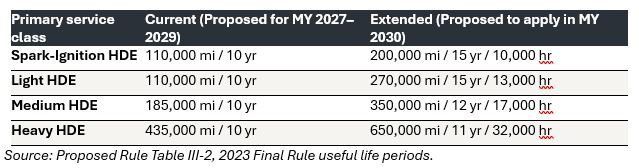
EPA proposes delaying longer useful-life requirements until model year 2030.
For fleets, the practical effect is that engines sold between model years 2027 and 2029 would remain subject to today's useful-life standards rather than the more aggressive requirements scheduled under the original rule.
The delay does not change the 2027 NOx standard itself. Instead, it provides additional time for manufacturers to demonstrate durability performance while minimizing the risk of recalls.
The table below compares the current useful-life standards and the extended standards that would take effect in 2030.
3. Specialized Vocational Equipment Gets More Flexibility
Many vocational, specialized vehicles—such as fire and garbage trucks—have difficulty meeting emissions requirements. Recognizing that reality, the 2023 NOx rule created a low-volume production allowance permitting manufacturers to certify a limited number of engines to pre-2027 standards.
However, access to that flexibility required manufacturers to surrender NOx credits, and several OEMs told EPA they lacked sufficient credit balances to make meaningful use of the provision.
EPA proposes removing the requirement for OEMs to use NOx credits to access the allowance for specialized vehicles while preserving other conditions to limit the impact on emissions.
4. EPA Would Create a Safety Valve Through Nonconformance Penalties
One of ATA's key recommendations was the creation of nonconformance penalties (NCPs), a long-standing exemption permitted by the Clean Air Act.
EPA proposes allowing diesel medium heavy-duty and heavy heavy-duty engine manufacturers to utilize NCPs if they cannot achieve the 2027 NOx standard on time. Engines would still have to satisfy emission limits, but manufacturers could temporarily certify products above the 35 mg/hp-hr NOx standard by paying a per-engine penalty tied to their level of noncompliance.
For fleets, the significance is straightforward: NCPs reduce the risk that certain engines disappear from the market. In practical terms, this could help avoid supply chain disruptions and maintain competition among engine manufacturers during the transition to the new standards.
5. Driver Warning Systems Would Replace Speed and Power Derates
Perhaps the most operationally significant proposal for fleets involves diesel exhaust fluid (DEF) inducements.
When a DEF issue arises, EPA proposes replacing speed and power derates with audible notifications. The audible alert would supplement dashboard warning lights, which are already required.
EPA threw its weight behind this proposal following operator testimony about derates causing unsafe roadside stops, towing bills, missed loads, and reputational harm. Additionally, EPA cited evidence that derates are often triggered for reasons unrelated to empty tanks or tampering.
6. Numerous Technical and Certification Requirements Would Be Updated
EPA’s proposal includes a series of technical amendments to align the heavy-duty powertrain testing and maintenance procedures with light-duty vehicle procedures to limit test burden for manufacturers that certify both light- and heavy-duty products.
While these revisions may not be as visible as other elements of the proposed rule, they could help reduce compliance complexity and support a smoother rollout of next-generation emissions technologies.
Bottom Line
Since 1970, trucking has reduced heavy-duty emissions by 99%. That is real progress. But EPA’s 2023 rule demanded another 80% reduction in NOx emissions in just five years, forcing our industry to confront costly, complex technologies that have not been fully proven in real-world conditions.
ATA has been clear from day one: new environmental standards must be achievable, affordable, and reliable. If a truck cannot perform safely and efficiently on America’s highways, then the freight does not move, shelves do not get stocked, and our economy pays the price.
Administrator Zeldin and the Trump Administration heard us loud and clear. By providing commonsense flexibility, EPA is supporting the manufacturers, fleets, and 8.4 million hardworking men and women who keep our country moving. At the same time, the proposed rule retains 90 percent of the projected NOx emissions reductions that were envisioned under the 2023 standards.
ATA will continue working with EPA throughout the rulemaking process and intends to submit formal comments supporting the proposal prior to the August 29 deadline. A public hearing is scheduled for July 29.