
Affordability. It’s the hottest buzzword in public discourse today.
Americans are clamoring for it. Politicians base their campaign messages around it. Pollsters confirm it’s a winning issue. Yet when rubber meets the road, too often, policymakers overlook the solutions that can meaningfully bring down costs for Americans.
That must change, and a good place to start would be to enact tort reform.
Every year, Americans pay a hidden “tort tax” that costs the typical household $4,207. But this tax isn't being used to pay for better schools, roads, and emergency services—it is simply lining the pockets of the trial bar. Billboard lawyers are increasingly filing frivolous lawsuits and “forum shopping” to score huge payouts. This exploitation of the legal system costs our economy over half a trillion dollars annually. Even worse, the wave of lawsuit abuse is swamping family budgets. As a top target for trial lawyers, the trucking industry bears a particularly heavy burden.
One of the most disturbing instances of lawsuit abuse—staged accidents—involves criminals intentionally crashing into 18‑wheelers, risking lives to cash in on massive settlements. Recently, a short documentary exposed a staggering scheme involving an organized network of “slammers,” corrupt attorneys, and even the murder of a witness who threatened to reveal the truth.
Clearly, the status quo of unscrupulous lawyers acting with impunity and driving up insurance rates is not working. Protecting the integrity of our justice system is simply common sense. Yet, inexplicably, Congress has dragged its feet on this issue. Fortunately, local legislatures are pointing the way forward.
Nearly a century ago, Supreme Court Justice Louis Brandeis famously described states as a “laboratory” of democracy. This feature of federalism has served as a proving ground for policies that can tackle serious problems in novel ways. The states that have had the temerity to experiment with tort reform have achieved transformational results.
Florida is a prime example of the paradigm shift that is underway. For years, the state was branded a judicial hellhole, but that changed in 2023. With the strong support of ATA and the Florida Trucking Association, Governor Ron Desantis pushed through legislation that created a level playing field for litigation and put an end to trial lawyers harassing job creators to line their own pockets.
The impressive statistics speak for themselves.
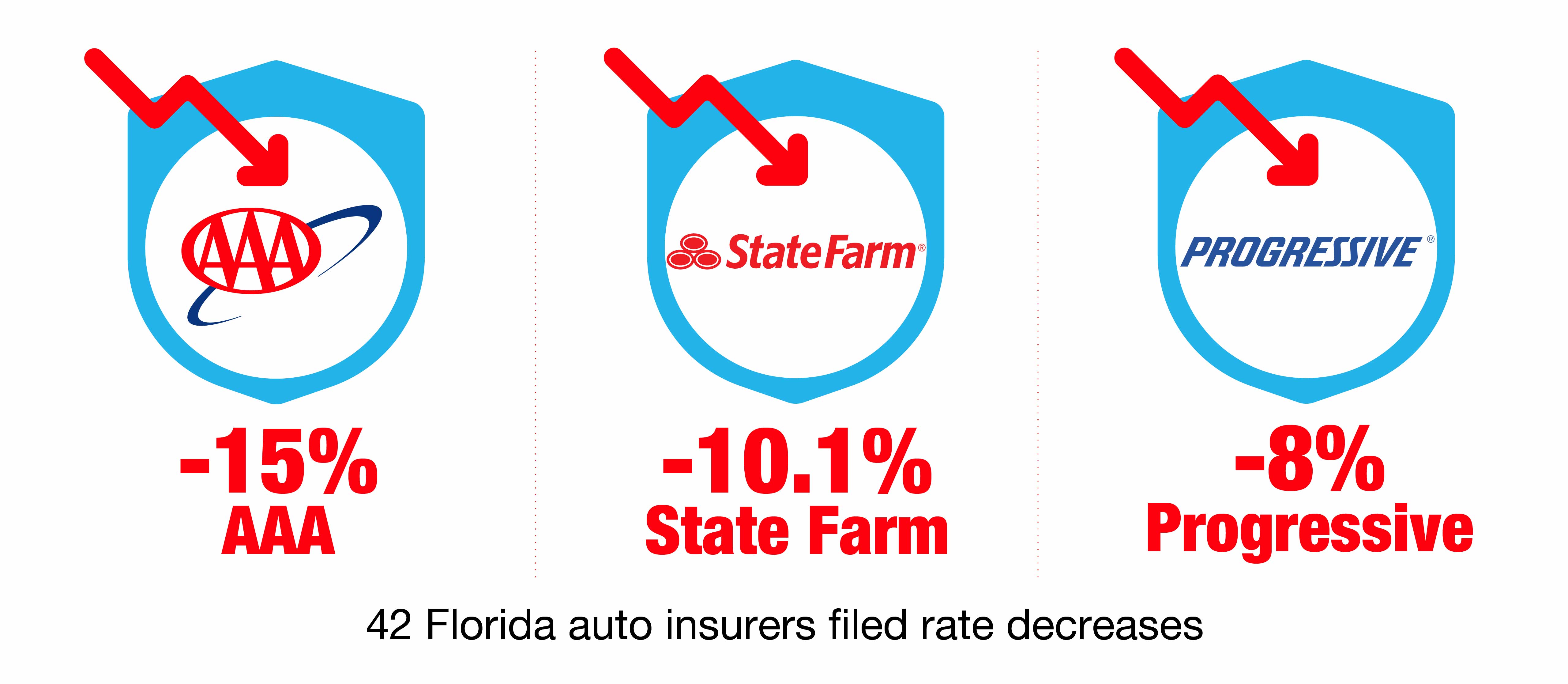

Since Florida’s reforms took effect, over three dozen auto insurers filed rate decreases according to Sentry Insurance. Policyholders received a reduction of 15% from AAA, 10.1% from State Farm, and 8% from Progressive, among many others. An analysis by the Perryman Group found that direct savings in the property and casualty market generate $4.2 billion in additional economic activity and support nearly 30,000 jobs.
The bottom line is that insurers want to do business in states with predictable, fair legal environments. This competition has created a windfall for Floridians, adding hundreds of dollars to their wallets, enabling them to pay their bills, boost their savings, support local businesses, and take that much-needed vacation.
To date, ATA’s advocacy has been instrumental to the successful passage of tort reform in 15 states, including Florida. Additional victories are on the horizon, but what we need above all is a federal remedy that can expand these reforms from coast to coast.
With Congress returning to session today following a two-week recess, they would be wise to look to Florida as a model. This week, 16 members of the Florida Trucking Association will be in town for Call on Washington to meet with their Members of Congress and urge them to translate their state’s tort reform triumph into a national one.
This is not a Red State vs. Blue State issue. At least, it does not have to be. Governor Kathy Hochul has courageously taken up the mantle to bring down New Yorkers’ sky-high insurance premiums.
If lawmakers are serious about lowering costs for their constituents, they must pass comprehensive tort reform legislation. There are a suite of policy prescriptions available.
A good place to begin to restore justice to the justice system would be to simply improve transparency that ensures judges and juries are entitled to all of the facts. As Justice Brandeis put it in another famous aphorism, “Sunlight is the best disinfectant.” Perhaps that is why the Sunshine State is leading the way.